
Articles
What is Art-Net and DMX? A Guide to Lighting Control Protocols
How lighting data travels from the show computer to every LED: DMX universes and addressing, Art-Net over Ethernet, RDM, and how they fit together in a Zenopix system.
Zenopix Teknoloji
Every lighting control system answers the same question: how does a color chosen on a computer reach a single LED on a facade hundreds of meters away? Two protocols do most of that work. DMX carries the data along the last meters to the fixtures, and Art-Net carries many DMX universes across an ordinary Ethernet network. This guide explains both, how they differ, and how they fit together.
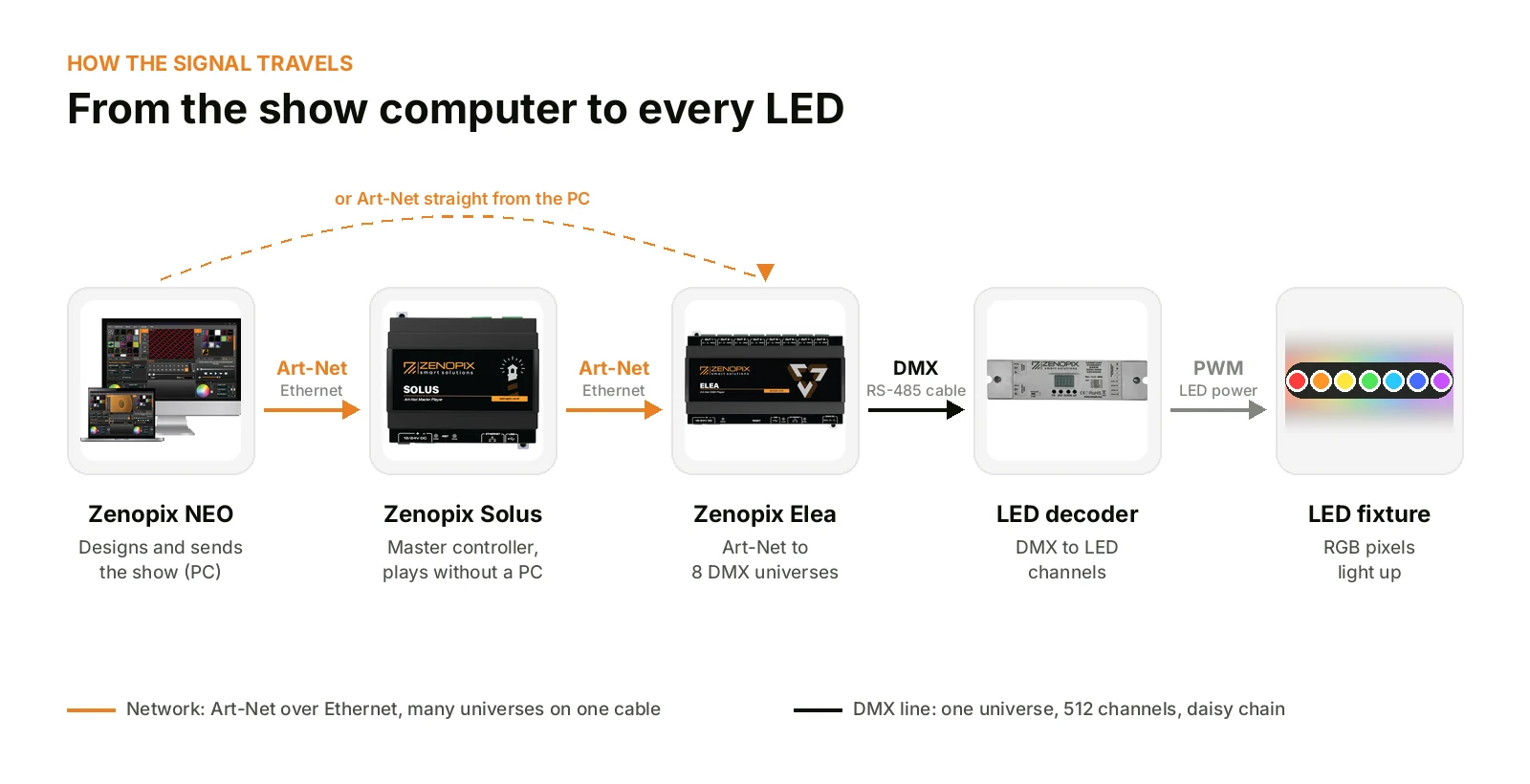
A typical chain: NEO or Solus sends Art-Net over Ethernet, Elea turns it into DMX, and the decoder drives the LEDs.
What is DMX?
DMX is the standard way lighting controllers talk to fixtures. It was created for stage lighting in the 1980s and is now standardised as ANSI E1.11. A DMX line uses RS-485 signalling over a twisted-pair cable at 250 kbit/s, and it carries one universe: 512 channels, each with a value from 0 to 255.
A channel controls one thing. On an RGBW LED decoder, four channels set the red, green, blue and white levels. Each fixture or decoder has a start address, and it listens to that channel and the ones after it. The controller sends the whole universe again and again, up to about 44 times per second, so changes look smooth.
- One universe = 512 channels, values 0–255
- Devices are daisy-chained from one to the next, never wired in a star
- A 120 Ω terminator goes at the last device on the line
- Up to 32 devices per line; a repeater starts a new segment
- Zenopix recommends keeping each cable segment at or below 100 m
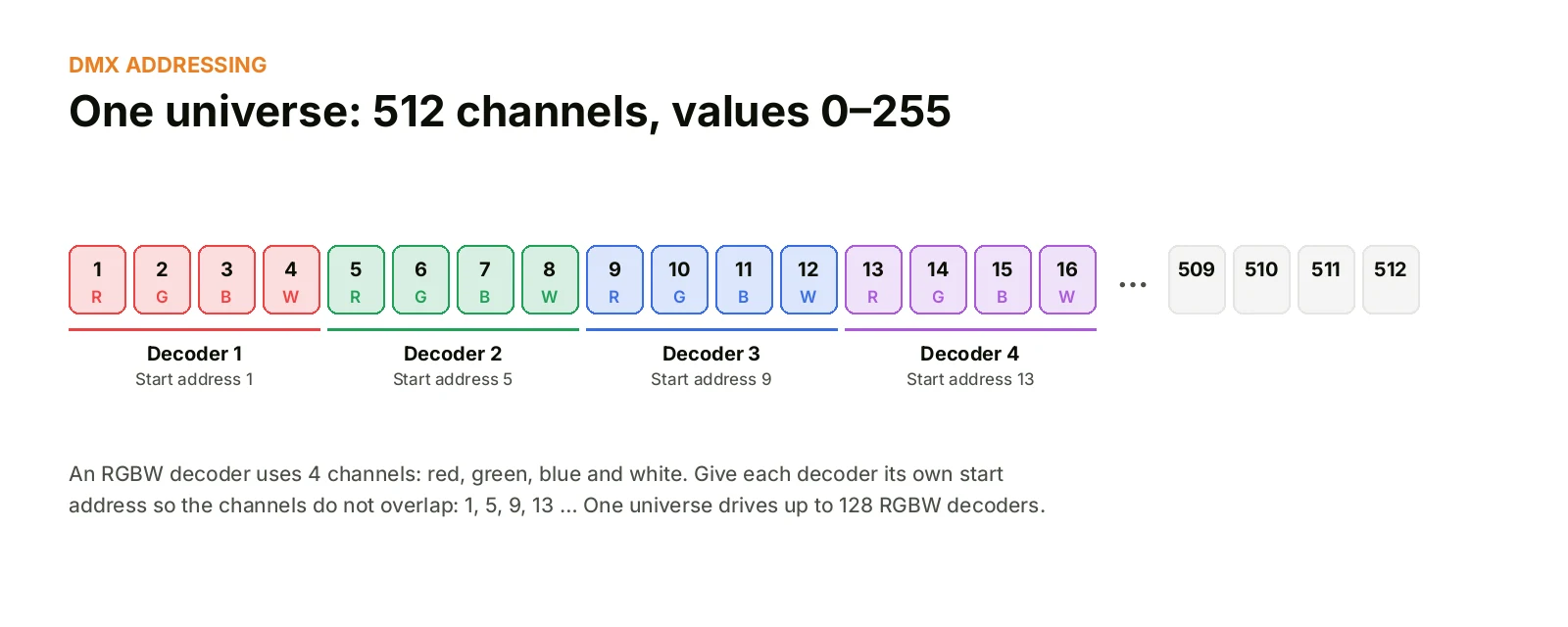
Four RGBW decoders share one universe: each takes four channels from its own start address.
What is Art-Net?
One DMX universe drives up to 170 RGB pixels (3 channels each), but a facade or a media wall can need tens or hundreds of universes. Running a separate DMX cable for each one from the control room would be impractical. Art-Net solves this by carrying DMX universes inside ordinary network packets (UDP over Ethernet), so one network cable and standard switches can move many universes at once.
Art-Net was created by Artistic Licence and is free to use. Art-Net 4 can address up to 32,768 universes. At the fixture end, an Art-Net node turns the network data back into DMX, or into SPI for pixel LEDs. Zenopix Elea outputs 8 DMX universes at 40 frames per second, and Zenopix Velox outputs SPI for pixel LEDs.
Art-Net vs DMX
| DMX | Art-Net | |
|---|---|---|
| Carries | 1 universe (512 channels) | Many DMX universes |
| Physical layer | RS-485, twisted-pair cable | Ethernet (UDP), network cable and switches |
| Topology | Daisy chain, terminated | Star through network switches |
| Where it is used | The last meters to fixtures and decoders | From the show computer or master controller to the nodes |
| Typical devices | Decoders, fixtures, repeaters | Software, master controllers, Art-Net nodes |
- Carries
- DMX
- 1 universe (512 channels)
- Art-Net
- Many DMX universes
- Physical layer
- DMX
- RS-485, twisted-pair cable
- Art-Net
- Ethernet (UDP), network cable and switches
- Topology
- DMX
- Daisy chain, terminated
- Art-Net
- Star through network switches
- Where it is used
- DMX
- The last meters to fixtures and decoders
- Art-Net
- From the show computer or master controller to the nodes
- Typical devices
- DMX
- Decoders, fixtures, repeaters
- Art-Net
- Software, master controllers, Art-Net nodes
In practice they work together: Art-Net moves the show around the building, and DMX delivers it to each fixture.
And RDM?
Plain DMX travels in one direction only. RDM (Remote Device Management, ANSI E1.20) adds replies on the same cable, so a controller can find devices, set their DMX addresses and read their status remotely, without climbing to each fixture. Zenopix Magus carries RDM over Art-Net, and Zenopix Explorer finds and addresses RDM devices from a computer. Keep in mind that a DMX-only repeater blocks RDM replies; use an RDM repeater on RDM lines.
Putting it together
A Zenopix installation follows the path in the diagram above. Shows are designed in Zenopix NEO, which sends Art-Net while you program. For installations that must run every night without a computer, Zenopix Solus stores the shows, plays them on a schedule and sends Art-Net to the nodes. Zenopix Elea turns Art-Net into DMX, and constant current decoders inside the fixtures turn DMX into light.
Checklist for a reliable DMX line
- Daisy-chain the devices; avoid star wiring and Y splits
- Fit a 120 Ω terminator at the last device
- Use twisted-pair 120 Ω RS-485 cable
- Stay within 32 devices and about 100 m per segment, then add a repeater
- Give every decoder its own start address so channels do not overlap
